How Can Los Angeles’ Schools Have a Looming $1.6B Deficit With $19B in Revenues?
Chad Aldeman | December 22, 2025
Your donation will help us produce journalism like this. Please give today.
The Los Angeles Unified School District has seen some impressive academic results over the last few years. But in pursuing those gains, district leaders have led themselves into a financially unsustainable position.
Its most recent proposed budget contains the blunt admission that, “L.A. Unified currently has a structural deficit whereby in-year expenditures exceed in-year revenues. As revenues continue to decrease due to enrollment decline and loss of one-time COVID funds, expenditures have not been reduced proportionately.”
How did a district with $18.8 billion in revenue this year get to the point where it is projecting a $1.6 billion deficit by 2027-28?
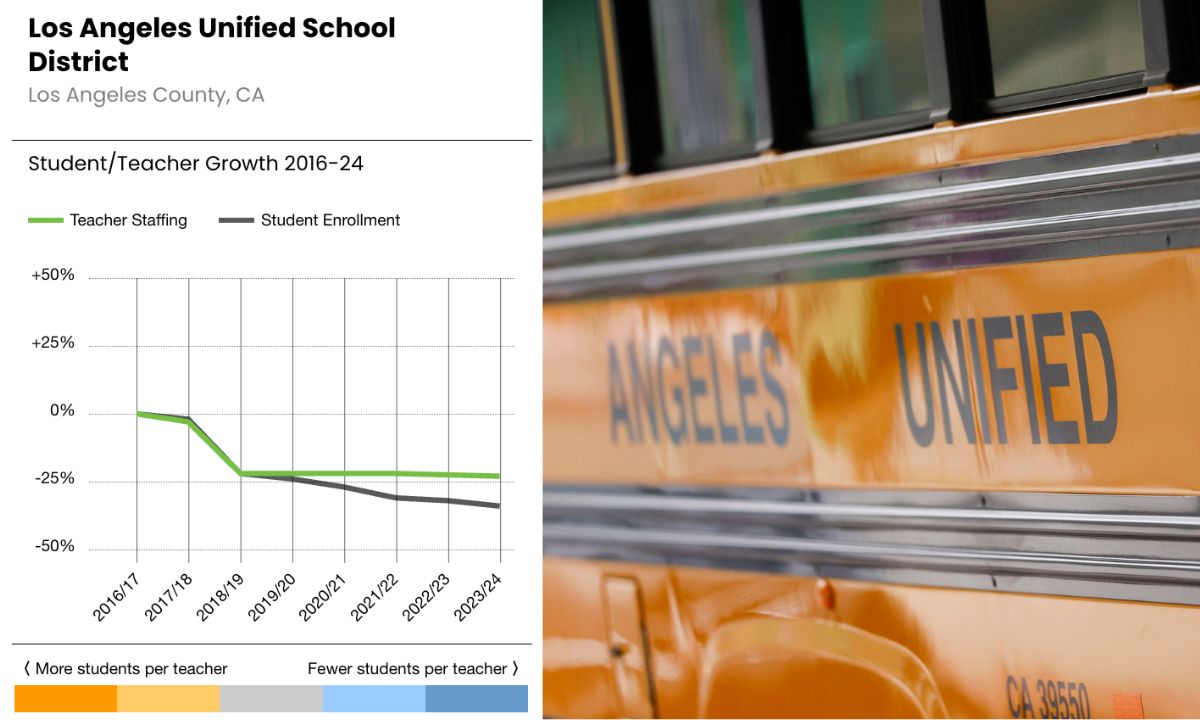
The problems start on the revenue side. Namely, the district keeps losing students. According to data it reported to the federal government, Los Angeles Unified served 495,255 students in 2018-19, the last full school year pre-pandemic. By 2023-24, that number had fallen to 419,929. That’s a decline of 75,326 students, or 15.2%.
That 15% decline is key to understanding the next few data points because the district did not reduce the number of staffers at anywhere close to the rate at which its student population declined. During the same period that it lost 75,000 students, it cut its teaching ranks by just 251. That represents a decline of 1.1% on the teacher side, compared with the 15.2% loss in student enrollment. It had a similarly small decline in non-teaching staff.
Effectively, Los Angeles reduced its student/teacher ratio over this time period from 22.5 to 19.3 students per teacher. As The 74 reported earlier this year, about three-quarters of districts across the country have reduced their student/teacher ratios in similar ways over the last few years, but Los Angeles had one of the bigger drops.
As it served fewer students, the district also failed to adjust the number of schools it operates. In 2019, it had 785 district-run and charter schools. Five years later, despite the 15% decline in the number of students it served, it operated the exact same number of schools — 785.
In practice, by not responding to the enrollment declines, the district now operates a lot of partially vacant schools. Between 2019 and 2024, 224 Los Angeles schools lost 25% or more of their students. It is far from the only district with very small schools, but it does have a particularly large number of them. In 2024, 52 Los Angeles district schools served under 100 students and another 68 had less than 200 students.
The Edunomics Lab at Georgetown University has compiled school-level spending figures across the country, and that data suggest that many small schools become very expensive to operate. For example, Marina del Rey Middle School in Los Angeles served 716 students in 2013-14. Ten years later, it taught only 369, at a per-pupil cost of $38,780. Similarly, Crescent Heights Elementary went from educating 384 students in 2013-14 to just 192 a decade later and now spends $37,967 per pupil.
So, how is the district proposing to get its budget back into balance? For now, it’s starting with accounting tactics like limiting the amount of money schools can carry over from one year to the next, closing unfilled school staff vacancies and cutting central office operations. It also hints that it will “consolidate” campuses and programs but doesn’t say exactly what that will mean. Elsewhere in the document, the district says it expects to save $130 million this year by cutting 1,291 teacher positions — a 7% reduction.
These cuts are necessary in part because the district projects it will lose another 35,000 students, a further 9% drop, by 2027-28. The one-time federal relief funds allowed Los Angeles to temporarily ignore the imbalance between revenues and spending it had accrued thanks to a bloated payroll and an unwillingness to deal with the messy business of closing or consolidating schools.
But it now has to resolve that deficit, and district leaders will face some tough decisions in the years ahead as they attempt to bring their budget back into balance while continuing to build on their recent academic gains.