Aldeman: Top 5 Schools in Each State Beating the Odds in 3rd Grade Reading
Chad Aldeman | January 28, 2026
Your donation will help us produce journalism like this. Please give today.
This article is part of Bright Spots, The 74’s series highlighting schools where every child learns to read, no matter their zip code. Explore the Bright Spots map to find out which schools are beating the odds in terms of literacy versus poverty rates.
In general, a school with a lower poverty rate is going to have higher test scores than one that serves a more disadvantaged group of students.
But that may or may not be due to anything the schools themselves are doing. And poverty is not destiny; around the country, schools are bucking that general trend.
Last year, we set out to find the schools that were doing much better at teaching third graders to read than their poverty levels might predict. After looking at data for nearly 42,000 schools, we identified 2,158 that we called Bright Spots. While these schools didn’t always have the highest absolute scores, their students performed much better than might be expected, based on their poverty rates.
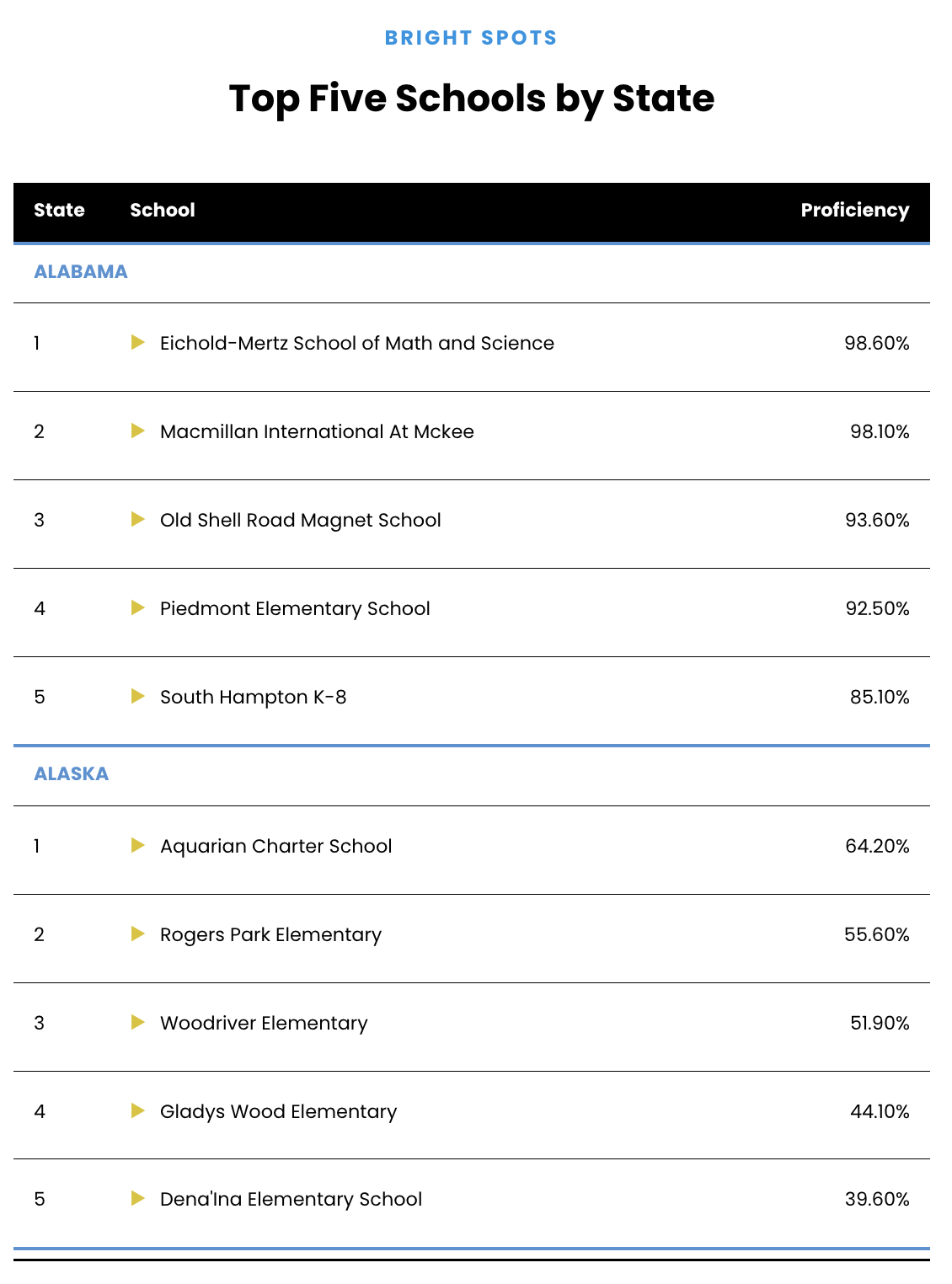
Today, we’re calling out 255 of those Bright Spots — five public schools in every state and Washington, D.C., that are beating the odds for their kids by the biggest margins.
For example, Merton E. Hill Elementary School in Orange County, California, had a student poverty rate of 87%. Given the relationship between poverty and reading outcomes across California, we expected the school to have just 29% of its third-graders reading proficiently. Instead, it surpassed 81%. As another example, Pocomoke Elementary School in Worcester County, Maryland, had 100% of its students qualify for free or reduced-price lunch, and yet it far exceeded statewide reading proficiency rates (71% versus 47%).
Scroll through the list below to find the brightest stars in your state.
Click on the chart below to view the interactive on The 74’s site
(For more information on how we identified these schools, see the “About This Project” section here. Or to see where these schools are located in your state, check out our interactive map.)