In San Francisco, Short Bursts of High-Impact Tutoring Support Young Readers
Kate Rix | February 19, 2026
Your donation will help us produce journalism like this. Please give today.
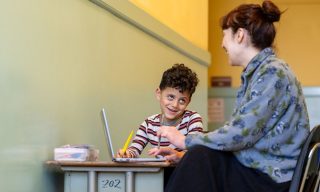
On a chilly morning at Leonard Flynn Elementary School, first graders played with jump ropes and hula hoops outside while reading tutor Lillie Reynaga set up her materials at a table in the hallway nearby. One by one, kindergarteners came to her table and practiced blending sounds to make one-syllable words.
“We’re going to make words and they’re all going to rhyme because they’ll all end with at,” Reynaga told 5-year-old Violet, who kicked her legs back and forth on the low bench.
For the next 15 minutes Violet repeated at-at-at and read mat, rat and fat.
“Now, do you have any guesses and what S and at come together to say?”
“Sat!” Violet called out.
“How did you know that this word is sat?”
“Because it starts with s!”
The benefits of high-impact tutoring are on full display at this Spanish immersion public school on the edge of San Francisco’s Bernal Heights and Mission District neighborhoods. Flynn introduced the program last year and saw almost immediate results.
Among the second graders who received tutoring in first grade, nearly a third started this school year reading at grade level or above, while more than half of students who did not work with tutors last year started second grade reading at a kindergarten level.
This year, those second graders are getting the support they missed out on in first grade, along with other Flynn students from kindergarten through third grade. Tutors trained and paid by provider Chapter One visit Flynn every day to deliver short bursts of high-impact tutoring in word recognition and language comprehension.
It’s not the first reading intervention Flynn has tried, said principal Tyler Woods, but it’s having the most impact.
“Literacy interventionists would provide intensive interventions but only serve 20 or 30 students across the school,” he said. “This is a lighter touch but focused on the areas that we know our kids really struggle with, and it just reaches a lot more students.”
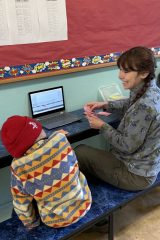
High-impact tutoring — a research-backed intervention characterized by its frequency, duration and alignment with school curriculum — has been so successful in San Francisco that district officials recently expanded the program to serve more than 2,700 students across 20 priority district schools.
“This is the single most effective literacy intervention we have,” said Ann Levy Walden, CEO of the San Francisco Education Fund, which helps to fund and implement the program in partnership with the school district. “This expansion allows us to do what we know works.”
Nearly half of students in San Francisco Unified schools cannot read at grade level. A year ago, the district set a goal that specifically targets third grade proficiency: By 2027, 70% of third graders will meet state standards, up from 52% in 2022. High-impact tutoring is one of the targeted supports the district is using to meet the benchmark.
“Ensuring students are proficient readers by the end of third grade is one of our most important student outcome goals,” said district superintendent Maria Su. The district also adopted a curriculum based on the science of reading last year — the first reading curriculum change in the district in a decade. This change, along with expanding tutoring, are meant to help “focus resources on the grade levels and school communities where high-impact tutoring can most effectively accelerate literacy development,” Su said.
The cost of high-impact tutoring is $500 a student, which includes up to four sessions a week, assessments, individualized tutoring plans, progress monitoring and integration with classroom instruction. The Education Fund raises money continuously, but a year of high-impact tutoring in San Francisco costs about $2 million. This year, the district contributed $830,000.
The district expanded high-impact tutoring after seeing results last year. After working with Chapter One tutors for five months last year, the number of students district-wide who met grade-level reading standards more than doubled, from 24% to 54%. At Sanchez Elementary in the Mission District first graders reading at or above grade level went from 15% to 59%.
At Guadalupe Elementary, in the city’s Crocker-Amazon neighborhood, the share of kindergarteners reading at grade level jumped from 39% to nearly 68%, after students participated in the tutoring program.
“It’s an early literacy gain that we have never seen before,” said principal Raj Sharma. Nearly 70% of students at Guadalupe are English learners, and about 10% are newcomers to the United States, Sharma said. “Sometimes our students don’t have any school experience at all.”
Sharma said he specifically chose to bring high-impact tutors in to work with very young students because he believed the impact for them could be so substantial.
“Once your foundation is strong, you can build the house on there,” he said. “Family or socio-economic status matters, but in our situation we saw that it’s beyond that. We can make a difference.”
A big challenge for school leaders is how and when to connect tutors with students. At Guadalupe, tutors meet with every student in a class either individually or in small groups in their classrooms. This approach is less disruptive for students, Sharma said, and allows for more continuity in their learning experience.
“They are just one of the small groups and others are with the Chapter One tutor, and then they can rotate,” he said. “They are not missing any instruction that’s given in the classroom. At the same time, they’re getting the reading foundations.”
Sharma and other principals said that the way high-impact tutoring is being delivered in San Francisco stands out, because tutors are trained and paid and because principals get help integrating the program into their schools. The San Francisco Education Fund partners with the San Francisco Literacy Project to help school leaders to develop schedules and determine which students will receive tutoring.
“The scheduling of it has been really seamless, which is not always the case when you’re trying to pair any type of extra support or intervention,” said Woods of Flynn Elementary. “Many of our students are needing support from the moment they join our school and in the past, we just haven’t had the scope of support to provide some meaningful development. This is the first time we’ve been able to say, let’s figure out who needs the intervention and everybody gets it.”