California’s Kitchen Nightmare: Union Demands Rise as Enrollment Falls
Michael Hartney | March 19, 2026
Your donation will help us produce journalism like this. Please give today.
Imagine a restaurant that is losing customers. Instead of cutting back, the owner hires more servers. As revenues decline, the waiters demand higher pay and more busboys to help them serve fewer customers.
That might sound like the premise of an episode of Gordon Ramsay’s Kitchen Nightmares. But something very similar is happening right now in California’s public schools. Worse still, there’s no celebrity chef coming to clean up the mess.
Even though public school enrollment has fallen sharply since the pandemic, most California districts have continued adding staff. Now teachers unions are pressing districts to commit to more expensive labor contracts, even as the funding they receive remains tied to the number of students they serve.
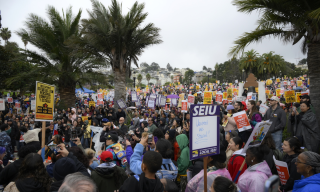
Earlier this month, teachers in two Sacramento-area school districts walked off the job after contract negotiations stalled, bringing the number of teacher strikes in California to six this school year. And more may be on the way. Unions in Los Angeles and Berkeley have already authorized strikes if negotiations fail.
These strikes are not isolated incidents. They are part of a coordinated statewide pressure campaign by the California Teachers Association (CTA) called “We Can’t Wait,” involving 32 districts that educate about 1 million of the state’s students. As the San Francisco Chronicle recently reported, the campaign has emboldened local unions to dig their heels in and make contract demands that go beyond what independent state panels have recommended.
How did we get here?
From the perspective of union leaders, the answer is simple: California’s schools are understaffed and educators are underpaid. “We have a staffing crisis, and it’s worst in areas where teachers are needed the most,” Kyle Weinberg of the San Diego Education Association argued. “If we want to fully staff our schools, we need a living wage.” Striking a similar tone, Kampala Taiz-Rancifer of the Oakland Education Association said: “Our students deserve smaller class sizes that allow them to thrive and feel safe at school.”
These local leaders are echoed by their counterparts in state headquarters. “There is no district anywhere in the state that is getting what they deserve from the state’s funding system,” CTA President David Goldberg told the Sacramento Bee. “It is a system that has gone on for decades and basically balanced budgets on the backs of our students and educators.”
But research produced by a union-friendly organization complicates that claim. A recent school finance profile from the Albert Shanker Institute finds that California devotes 3.4 percent of its economic capacity to K–12 schools, compared with a national average of 3.1 percent. In other words, California already commits 10% more of its economic capacity to public education than the typical U.S. state.
Many union leaders say that California districts have prioritized administrative spending over investing in teachers and classroom support staff. Yet in Twin Rivers Unified School District, where teachers are currently on strike, the data point in the opposite direction. Combining figures reported by district officials with state data on teacher contracts shows that starting teacher pay in the Sacramento-area district has increased about 35% since 2019, rising from $48,168 to $65,228—roughly equal to the median household income there.
Meanwhile, NCES data reported by Marguerite Roza’s Edunomics Lab shows that administrative and central office staffing in Twin Rivers has been slashed while the number of teachers and paraprofessionals has grown, even as enrollment has fallen.
The slogan “We Can’t Wait” also carries an unintended irony for parents and students. Research has consistently shown that districts that relied more heavily on remote instruction during the pandemic experienced larger post-pandemic enrollment declines as parents sought alternatives when schools failed to reopen.
According to my own analysis of AEI’s Return 2 Learn tracker, the 32 districts participating in the CTA campaign spent nearly 80% of the 2020–21 school year in fully virtual learning, while the rest of California’s districts were remote for closer to half that school year. Twenty-one of the 32 districts never reopened for a continuous week of fully in-person learning that year.
Many families apparently voted with their feet. Since the pandemic, NCES data shows that the 32 districts participating in CTA’s campaign experienced average enrollment declines of about 8%. Comparing these districts to their neighbors within the same counties — a fairer apples-to-apples comparison — enrollment in “We Can’t Wait” districts fell about 3 percentage points more than in nearby districts that are not part of the campaign.
In other words, the union locals striking — or threatening to strike — are concentrated in districts that have lost a larger share of their students since the pandemic and are therefore more vulnerable to structural deficits.
State policymakers haven’t helped. California expanded “hold harmless” rules that allowed districts to be funded based on prior-year attendance rather than the number of students actually showing up. Because those protections were strengthened during the pandemic, the fiscal impact of enrollment losses did not fully hit district budgets until around 2024,especially after federal ESSER funding expired. In effect, districts were being paid based on yesterday’s students rather than today’s. It was like a restaurant paying this year’s servers with last year’s reservations.RelatedCalifornia School Districts Issue Thousands of Pink Slips to Close Growing Budget Deficits
Which brings me back to the slogan “We Can’t Wait.” During the pandemic, students and families were the ones told to wait: for classrooms to reopen, for normal schooling to resume, for the adults in charge to figure things out. Families were told to be patient, even as many quietly began leaving the system.
Now many of the same union locals that kept students waiting the longest are warning of a five-alarm fire. But emergencies caused by earlier choices have a different name.
They’re what happens when the customers leave and the bill finally comes due.
As Marguerite Roza recently predicted, “To balance [their] budget, districts will issue pink slips, cut some electives, Advanced Placement classes and sports, eliminate supports for high-needs children, freeze hiring and close schools.” Unfortunately, that prediction is already coming true. Across California, districts have issued thousands of preliminary layoff notices as they scramble to close widening budget deficits.
We can’t wait any longer. That’s just the math.
Michael Hartney is the Bruni Family Fellow at Stanford University’s Hoover Institution and an associate professor of political science at Boston College.