A Year After Fires Scorched L.A. Schools, Difficulties Plague Reopenings
Ben Chapman | January 21, 2026
Your donation will help us produce journalism like this. Please give today.
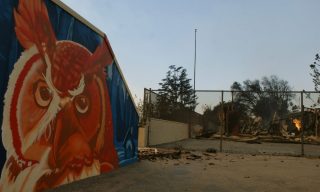
A year has passed since historic wildfires scorched vast swaths of Los Angeles and eight schools, where enrollment is still a fraction of what it was before the fires.
The schools have mostly reopened after prolonged closures, using temporary classrooms. But the fires, which killed dozens and left thousands homeless, have chopped enrollment by half at some of the affected schools.
“Families went with schools that weren’t impacted by the fires,” said Bonnie Brimecomb, principal of Odyssey Charter-South, which was destroyed in the Eaton blaze. “And then we have other people that are just nervous about coming back [because] it’s a lot to see and be a part of.”
Odyssey South, located in the Altadena area of Los Angeles, reopened on three temporary campuses from January to June of last year including a Boys and Girls Club, an office in Old Town Pasadena, and classrooms at the nearby ArtCenter College of Design.
By fall, the main campus reopened in a school building that was formerly used by another charter, but many families chose other schools or left the area, with enrollment falling to 183 from 375.
Despite the trauma, students were resilient, improving test scores and good classroom behavior, said Brimecombe.
“It’s just a complete surprise at how well the kids have gone through this process,” she said. “The kids are happy, the kids are smiling, they are learning, they are fine. The kids are happy, happy to be back together.”
Still, enrollment challenges persist, and the school has had to let go of a handful of teachers and teaching assistants. The school’s original building felt more like home, Brimecombe said, but kids who have stayed at the school are thriving.
Odyssey South has put new supports in place for students’ including an on-site counseling team that was expanded this year to increase access for students.
The school also brought in art therapists to run a series of sessions with different grade levels, and a counseling team that visits classrooms for structured sessions on topics that surface for specific age groups.
Teachers have also increased the number of field trips at the school to give students “happy situations” and positive experiences away from the fire-affected environment, Brimecombe said.
Odyssey South was able to maintain its previous levels of programming this year but may have to make cuts next year if current funding levels don’t persist, Brimecombe said.
That’s largely a matter of enrollment, since Odyssey South, like other public schools in LA., receives its funding on a per-pupil basis. With half of the school’s students gone, the future is uncertain.
Still, the principal is hopeful.
“Families are coming back,” Brimecomb said. “They’re just not back yet.”Enrollment problems also persist in the Palisades, where three schools were burned, said LAUSD school board member Nick Melvoin, who represents the area.
Palisades Charter High is holding up the best, with about 2,500 students, down from about 2,900 pre-fire. Marquez Elementary has about 130 students, a little less than half of pre-fire enrollment. Palisades Elementary has about 300 students, down by about 100 from pre-fire levels.
Students returned to Marquez Elementary into portable, temporary buildings in the fall. Palisades High students are returning to their school building on Jan. 27, and Palisades Elementary students continue to attend school at their co-location site at Brentwood Science Magnet.
New, rebuilt facilities for all three schools should be completed by fall 2028, “but all three schools are kind of a slightly different journey from now until then,” said Melvoin.
“The families that have been displaced, that are in other parts of L.A. and the country, are either coming back eventually or not,” he said of enrollment drops. “Some families who were not satisfied with the co-located option or didn’t want to be back in the Palisades just yet because of environmental concerns, are still in other schools.”
The district is giving flexibility in where families choose to enroll, said Melvoin, who expects enrollment in the displaced schools to improve.
“We’re going to have some new enrollment for the coming months, as people realize like, ‘Oh, I’m moving back to my house,’ or ‘my insurance money ran out, and so now I’m back in the Palisades,’ and there’s only a few schools that are open,” said Melvoin.
Besides environmental concerns, Melvoin said, families that are staying away due to a lack of infrastructure in the fire-scorched area, and because of trauma.
“The burn scar is still there,” he said. “You’re still driving past a number of destroyed buildings and houses. There are just some families who aren’t ready to put their kids back there yet.”
Many families are hopeful because schools are returning, construction is visible, and some businesses are coming back, said Allison Holdorff Polhill, a district director who works in Melvoin’s office and longtime Palisades resident who lost her home in the fires.
Virtually all residents were under‑insured, and there is still a strong need for federal money, grants and loans to cover rebuilding gaps, said Holdorff Polhill, and people are frustrated by slow government planning and being scattered in rentals or forced into assisted living.
“Every single friend’s home burned to the ground,” said Holdorff Polhill. “People are still traumatized by what happened.”
LAUSD has set aside $604 million for the full rebuilding of the impacted areas in the Palisades, including the three burned schools, LAUSD Superintendent Alberto Carvalho said.
The money will provide for the full rebuilding of Marquez Elementary, which was destroyed, plus new buildings and improvements to existing ones at Palisades Elementary, where about 60% of the campus was burned.
At Palisades High, about 30% of classrooms were destroyed and the remainder are being rebuilt.
The school is famous for being a popular filming location for Hollywood movies such as Carrie, Freaky Friday, and Teen Wolf, and for notable alumni including J.J. Abrams and will.i.am.
Pali High students have been attending classes in a former Sears department store building while construction is underway to repair fire damage.
The school’s campus is scheduled for reopening when work is completed later this month.
Carvalho said the district is still working to recover about $500 million of the expected construction costs from insurance companies.
“The rest we will seek FEMA reimbursements, which we believe we are absolutely legally entitled to,” Carvalho said. “We hope that the federal government will not play games, political games as we seek these reimbursements.”
In addition to these investments, the district will spend in excess of a billion dollars, all funded through Measure US, a $9 billion bond referendum approved by voters in 2024, to build higher levels of fire resilience at schools across the district.
“That means anything from replacement of filtration systems, the acquisition of air purifiers, new filtration systems for schools, HVAC systems, and replacement of roofing structures and windows with materials that withstand fires,” Carvalho said.
LAUSD has installed more than 230 air quality sensors on school buildings, covering every campus in the district, Carvalho said.
The sensors detect nauseous fumes, particulate matter in the air, and also measure temperature and wind speed, enabling school officials to make emergency decisions in case of fires, he said.
“Prevention is the best solution for fires,” said Carvalho.