Education Was Never Meant to Be a Market. It Was Meant to Be a Lifeline.
Marcos Aguilar and Minnie Ferguson | March 5, 2026
Your donation will help us produce journalism like this. Please give today.
If you spend enough time in public schools, you start to notice a pattern: Every year, districts warn of another round of cuts, another school closing, another program squeezed out of existence. Families hear about declining enrollment; teachers hear about shortages and burnout. Somewhere in the middle of all this, a quiet idea has taken hold — that public schools must run more like profitable businesses if they want to stay afloat.
We’ve worked in education long enough to know that idea is not only wrong, it’s dangerous. And if educators let it guide the future of schooling, we’ll hurt the very children we say we’re trying to serve.
For more than two decades, we have led Anahuacalmecac International University Preparatory of North America, an Indigenous, community-based public charter school in Northeast Los Angeles. We started this school because we believe education is not just a service — it’s a sacred responsibility that communities carry together. It is how communities sustain themselves, how culture is carried forward and how children learn to protect the world they will inherit. It was never meant to be a marketplace.
Yet the U.S. educational system increasingly treats it as one.
Schools are pressured to compete for students, buy pre-packaged curricula from multibillion-dollar publishing companies and outsource major decisions to consultants with a focus on standardization. Anyone who has sat through those meetings knows how quickly the conversation shifts from students to numbers. We’ve seen teachers, parents and even children reduced to data points.
These aren’t random shifts. They are all part of a growing push to marketize education.
You can see this trend in national politics as well. Recently, President Trump highlighted a $6.5 billion donation from Dell meant to set up trust funds for children to invest in the stock market. It was framed as an investment in their future. But it also sends a message: that children’s opportunities will depend not on the strength of their education or the support of their communities, but on their relationship to speculative financial markets.
At the same time, efforts to dismantle the U.S. Department of Education would place schools even more at the mercy of market forces. Yes, schools need funding. Yes, a functioning economy matters. But if schools teach children that their futures begin and end with the stock market, they are failing them. Their creativity, their relationships, their roots in community and their future—those are the things that actually carry them through life.
We know this because we’ve watched it happen at our school.
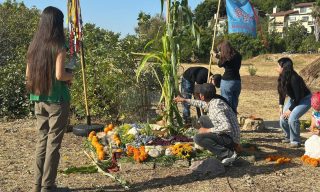
For 23 years, Anahuacalmecac has drawn from Indigenous knowledge systems, systems that kept communities alive on this land long before California was called California. Our students learn Nahuatl, English and Spanish. They plant gardens and learn where their water comes from. They study their own histories, including the parts of California’s story that don’t make it into mainstream textbooks. They participate in cultural protocols. They learn that they belong to a community and that their choices matter.
This isn’t nostalgia. It’s preparation for the world they’re inheriting.
In parts of Los Angeles, kids grow up breathing unhealthy air and drinking water that isn’t always safe. Their families struggle with rent. Parks and open land disappear to development. The effects of climate change show up in severe weather and devastating wildfires, in asthma rates and in the daily lives of students. These crises aren’t limited to L.A., or even California. This is the reality for many children across the country — and the globe.
Schools can’t pretend these conditions don’t exist. Our job is not simply to help young people navigate crises; it’s to give them the tools and imagination to change them.
That requires something beyond training students for the workforce. It means teaching resilience, curiosity, cultural memory and responsibility to the places they come from. It means helping them recognize that their value is not determined by an economy, but by their ability to strengthen their communities and repair what has been harmed.
This approach isn’t just Indigenous. Denmark’s education system — a model U.S. policymakers often praise — focuses on creativity, collaboration and student well-being. Danish children aren’t pushed into competition at every turn or told that their future hinges on financial speculation. They are taught to think, to create and to care for the world they live in. The U.S. could learn from that.
At our school, we’ve seen firsthand that when students understand who they are and what they carry from previous generations, they don’t run from hard problems. They move toward them with confidence.
So we have to ask: What if our public education system centered on children’s well-being instead of the demands of the market? What if schools invested as much in belonging and culture as they do in standardized tests and outside consultants? What if they trusted communities — and children — to shape solutions that actually address the problems they face?
The crisis in public education isn’t because families or teachers failed. It’s because its roots in colonial missions to civilize our ancestors, factory models of training wage laborers and Native American boarding schools committed to destroying culture and language still embody the illusion of democracy through government schooling.
Educators can choose to transform this reality.
When we all create schools grounded in dignity, culture, connection and care, we prepare young people not just to face the future but to shape it. And if we want a healthy society — one capable of meeting climate, social and economic challenges — there is no better investment than that.