Heat, Fires, Hurricanes, Floods: How Climate Change Is Keeping Kids From School
Wayne D'Orio | September 10, 2026
Your donation will help us produce journalism like this. Please give today.
With five simple words last year, Maine issued guidance that speaks volumes about how extreme weather is changing school. The law, Temperature Standards for School Buildings, clearly calls for each district in the state to set minimum and maximum temperature limits under which schools can operate.
What’s left unsaid in this bill is what any Mainer has experienced recently: The weather is changing drastically. “My daughter’s classroom was 96 degrees” a few years ago, said Jeremy Ray, the superintendent of both the Biddeford and Dayton school departments in Maine. “Thirty-five years ago, no one had heard of a heat day,” he added.
Maine is far from alone. A quick glance at a map of weather-related school closures from UndauntedK12 shows that since the 2020-21 school year, all but two states have faced school closures due to extreme weather. In fact, the nonprofit organization estimates that weather disrupted school for 9 million students in 10,000 schools during the 2024-25 school year. In California alone, students lost about a half-million hours of instructional time in the last school year, says Jonathan Klein, the organization’s co-founder and CEO.
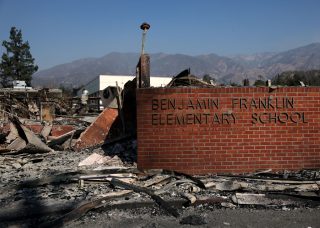
And these issues aren’t stopping. As of Sept. 2, before school even opened for some districts, there have already been at least 30 school closures or disruptions in 14 states, ranging from floods in Indiana to wildfire smoke in California to power outages caused by severe storms in Tennessee.
“This is happening all over the country,” said Klein, adding that the nonprofit’s site likely undercounts the extent of the problem. “This phenomenon is happening everyday.”
Add these closures to the stubborn chronic absenteeism trend that hasn’t faded much since the pandemic, and it becomes obvious that school has become more disrupted for more students. Today, more than one in five students will miss 18 school days each year, hitting the mark to be classified as chronically absent.
Even though weather-related school closures don’t count as absences and can be rescheduled, they represent missed time in the classroom. And missing a week of school can compound student learning loss for up to three weeks, according to a 2024 report from NWEA. The effects don’t stop only when schools are closed; a UCLA Luskin Center for Innovation report shows that for schools without air conditioning, a one degree rise in temperature can decrease student learning by 1%.
That data backs up a study in New York state that linked academic achievement increases to schools which improved their building’s heating, ventilation and air conditioning, said Lucy Sorensen, an associate research professor at the University of Albany. Sorensen and two other researchers examined 3,000 schools over 14 years and found that schools making HVAC improvements saw attendance gains, fewer suspensions and “modest” increases in student math and reading scores.
That’s the good news. The bad news is that at a time when education funding is tight, schools are older than ever, and fixes can be expensive. The average age of public schools is 49 years old, with more than half of those buildings needing, at a minimum, significant repairs.
Nationwide, the American Society of Civil Engineers has given school infrastructure a D+ for three consecutive years, while noting that the country’s infrastructure had improved during that period. A 2021 report estimated that 13,700 schools still need air conditioning at a cost of $40 billion.
Take Ann Arbor, Michigan, for example. In a district with more than 16,000 students and 32 schools, the average building age is 70, with five of its historic buildings more than 100 years old. While those buildings “are well loved by the neighborhood,” making improvements to keep up with weather challenges are difficult, said Jason Bing, the director of capital programs for Ann Arbor Public Schools.
The classroom temperature inside the top floors of schools has topped 90 degrees, he said, while schools also closed during last January’s polar vortex when wind chill temperatures plunged to well below zero. “We’ve definitely seen greater extremes,” Bing added.
Work in Philadelphia shows how expensive it can be to update old school buildings. Pre-pandemic more than half the city’s 218 schools didn’t have air conditioning; the city used COVID relief funds and a $200,000 donation from Eagles quarterback Jalen Hurts to address the problem. But four years into the work, more than 50 schools still lack air conditioning, and 52 schools closed early last week because of hot classrooms.
In California, nearly 20% of a $1 billion account created to fund school HVAC and plumbing repairs went unspent and will be returned to the utility companies that originally funded the work. More than 4,500 schools used the fund to assess HVAC systems, but only 172 schools made significant upgrades using the money.
While Sorensen’s study showed that academic achievement can improve when building infrastructure is upgraded, it also showed that low-income students and students of color are more likely to attend schools with poor HVAC systems, a factor that she said contributes to the lagging academic achievement for those student populations.
In New York state, not counting New York City, about 18% of Black or Hispanic students attend schools with inadequate ventilation systems compared to 13% of White or Asian students, the study reported. Digging deeper on this issue, a new paper that Sorensen helped write shows that “schools serving more students of color are significantly more likely to have poor overall conditions, inadequate ventilation [and] mold exposure.”
Klein points out that while more than 700,000 students were affected by the Los Angeles wildfires in 2025, 75% of those students were socioeconomically disadvantaged, 60% were Latino, and 40% multilingual learners.
Up to 5% of the racial achievement gap between test scores for Black students and their white peers can be explained by excessively hot classrooms, Klein added, citing the UCLA Luskin Center report. “For schools with air conditioning, the negative effects virtually disappear,” he added.
One of UndauntedK12’s goals is to help schools leverage federal energy tax credits to install ground-source heat pumps.
Back in Maine, Ray says two new elementaries are slated to open in 2028 and both will employ geothermal heat pumps. But until then, he’ll continue to cobble together methods to keep his schools comfortable.
Of course, extreme heat isn’t the only weather-related problem Maine schools face. Most of the state expects to close school about five times a year for snow, but lately power outages, floods and ice have been affecting when schools are in session, Ray said.
The state is warming faster than the global average, and the Maine Climate Council estimates that in 60 years the climate of the most northeastern state in the contiguous United States could resemble current conditions in New Jersey.
Ray leaned on OSHA guidelines to set his district’s temperature standards as requiring action if classrooms are below 40 degrees or above 99 degrees, both of which could become pretty uncomfortable for students. But his concerns don’t end when the final bell rings because “once these buildings heat up, they just don’t cool down,” he said. The district has used industrial fans at night to try to lower building temperatures, but even that has limited effectiveness. “In the first week, it’s very challenging for educators to do academics,” he admitted.