Your donation will help us produce journalism like this. Please give today.
Education policy and Hollywood rarely intersect.
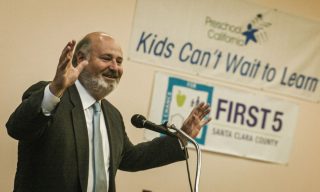
But when filmmaker Rob Reiner latched onto the science about how young children develop, he not only used his moviemaking platform to convince the public of the importance of kids’ early years, he became a real-life policymaker to champion the cause.
After successfully steering the passage of a 1998 tobacco tax in California to fund programs for kids from birth to 5, he chaired the statewide commission overseeing how some of the funds were spent. The entertainment community remembered Reiner’s legacy as a director this week, after he and his wife Michelle Singer Reiner were found dead in their home. But others reflected on how he kept early-childhood development in the spotlight.
“There are plenty of Hollywood actors, directors and leaders who engage in politics, write reasonably sized checks and do their best to make a difference. That was not Rob,” said Ben Austin, a former Clinton White House staffer who handled communications for the California Children and Families Commission and quickly rebranded it as First 5. Twenty-seven years later, the work continues. “This was not a side hustle.”
For an education reporter, it was a big deal. I first interviewed Reiner and his wife in a suite at what was then the Mirage Hotel and Casino in Las Vegas in 1997. Early-childhood education was my beat, and he was there to talk to the nation’s governors about his I Am Your Child campaign. He wanted to start a movement and had the high-level connections to do it. The effort kicked off earlier that year with a White House event and a star-studded ABC show featuring celebrities such as Tom Hanks and Billy Crystal. With big-name corporate sponsors like Johnson & Johnson and AT&T, the initiative included a special edition of Newsweek and a series of parent-focused videos that translated the latest science on early brain development to a general audience.

As a new mom, I couldn’t help but feel a personal connection to the topic. I reported on the policy goals of the campaign, like parent education and improving the quality of child care, while taking in the advice about reading and having back-and-forth conversations with my infant daughter.
It was a 1994 report called Starting Points, from the Carnegie Corporation of New York, that sparked Reiner’s activism. The authors explained how the first three years of life were a critical period of both risk and opportunity.
“An adverse environment can compromise a young child’s brain function and overall development,” the authors wrote. “A good start in life can do more to promote learning and prevent damage than we ever imagined.”
Michael Levine, a co-author, remembers sitting in the Reiners’ home theater in 1995, presenting the research to a small group, including actor Warren Beatty, actress Kate Capshaw and then-Disney Channel President John Cooke. Reiner, Levine said, wanted to replicate a Hawaii program called Healthy Start, which promoted understanding of child development and parents’ relationships with their babies. Then Beatty spoke up.
“He said something to the effect of ‘I’ve been listening to this whole conversation about programs and philanthropy. What we can do is sell early childhood to America,’ ” Levine recalled.
That pivotal moment took place in the same home where police said the Reiners were stabbed to death. The Reiners’ young children were there at the time, Levine said. On Sunday, their son Nick Reiner, 32, was arrested for the murder. On Monday, police said their daughter Romy found their bodies.
Despite being a far-left Democrat, Levine said Reiner found agreement with Republican governors, like Pennsylvania’s Tom Ridge and George Voinovich of Ohio, over early-childhood issues.
While I Am Your Child was a nationwide effort, Reiner kept his political strategy focused on California. In November 1998, voters narrowly passed his ballot measure, creating a 50-cent tax on tobacco products, beating back a $30 million effort from cigarette makers to defeat it. The revenue would fund programs to improve the health, school readiness and well-being of young children.
Reiner’s ability to combine his creative talent with political mobilization was “unprecedented in the early-childhood field,” Levine said.
A year later, I met Reiner in his Castle Rock Entertainment office in Beverly Hills, where posters of his hit movies, like “A Few Good Men,” and “When Harry Met Sally” line the walls.
First 5 was facing legal challenges, including a repeal effort sponsored by the president of a business called Cigarettes Cheaper. An author, John Bruer, was also poking holes in the whole idea behind First 5, arguing that Reiner was oversimplifying the science and creating stress for parents about making the most of their kids’ early years. Reiner brushed off the criticism.
“Let’s say there is no evidence,” he told me. “Would you then say, ‘Let’s not invest in child care for young children; let’s not invest in health care for young children?’ ”
The repeal effort failed and until 2006, First 5 occupied almost as much of Reiner’s time as his movies. He presided over statewide commission meetings, and could “code switch” between directing a scene and handling First 5 business, Austin said. In 2002, Austin remembers grabbing some time with Reiner on the set of “Alex and Emma,” a love story starring Luke Wilson and Kate Hudson.

“We’d schedule with the producer like 15 minutes for me to talk to Rob in his trailer about early-childhood policy,” he said.
One of Reiner’s biggest wins during that period was getting First 5 leaders in Los Angeles County to commit $100 million toward expanding preschool.
“This is a historic day for the children, not only of L.A. County, but of the country,” he said at the time. “This is going to be the model.”
He didn’t want to stop there. In 2006, he got a measure on the ballot that would tax California’s wealthiest residents to pay for pre-K for all 4-year-olds. With “strong will and enormous confidence,” he had little patience for those who might hurt the initiative’s chances of passing, said Bruce Fuller, a University of California Berkeley professor who advised Reiner’s team on the proposal.
“Reiner was not necessarily the world’s greatest listener,” Fuller told me. The plan called for the California Department of Education to set standards for the program and county school superintendents to run it. Fuller thought that was a mistake because it would take kids away from private providers — an opinion Reiner’s team rejected. But Fuller described Reiner as someone “who committed a ton of time and had a big heart to advance the issue.”
Voters rejected the pre-K plan. But today, despite declining revenue, First 5 continues to fund the statewide commission and 58 county-level agencies. They pay for a broad range of services, from home visiting for teen parents to training preschool providers. In 2018, I wrote a series of articles marking the 20th anniversary of the ballot measure.
Reiner didn’t agree to an interview that time. But First 5 L.A. shared some of his thoughts as he reflected on what drew him to become an early-childhood education advocate.
He was partly motivated by his own early experiences.
“As somebody who went through therapy, I started thinking about my early years and how they affected me,” he said.
But he also saw a political opportunity.
“Goals 2000 had just come out,” he said, referring to the Clinton-era education agenda. “The first goal was ‘All children will start school ready to learn.’ And I looked at all this and I said, you know, it seems to me if you could meet that one goal, if you could just make sure that every child has what they need to be healthy and ready to experience kindergarten, maybe all those other goals would kind of fall into line.”
This article was published in partnership with The 74. Sign up for The 74’s newsletter here.