52 Million U.S. Kids Eligible for New Scholarships, but California Hasn’t Opted In
Linda Jacobson | July 28, 2026
Your donation will help us produce journalism like this. Please give today.
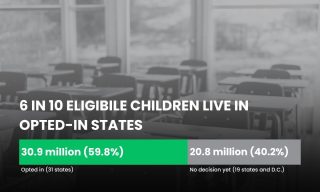
Nearly 6 million children in California would be eligible for a scholarship under the new federal tax credit for education, more than in any other state, new data shows.
But unlike other states with millions of eligible students, like Texas, Florida and New York, California hasn’t opted into the new Treasury Department program, and so far, there’s no sign it will.
That’s one takeaway from a report issued Tuesday by advocates showing the number of students in each state who would qualify for the funding under the Education Freedom Tax Credit. Overall, 51.7 million children in public, private and charter schools could potentially receive a taxpayer-funded scholarship, according to the analysis from the American Federation for Children, the leading advocacy group behind the legislation. Past estimates have shown how much scholarship granting organizations, or SGOs, might raise from donors each year and what the tax credit might cost the federal government in lost revenue. But author Patrick Graff, a senior fellow at the organization, said it was important to look at the program from another angle.
“Who are the kids that would actually benefit from these programs, and who are the families that would receive services that they otherwise wouldn’t receive?” he asked. Founded by former Education Secretary Betsy DeVos, the federation has historically championed private school choice.
But with public school students able to receive funds for tutoring and other supplemental programs, Graff expects district superintendents “especially in states where there are going to be budget crunches to strongly call on leaders” to participate, if not next year, then in 2028.
To calculate the number of eligible students, Graff used Census Bureau estimates and survey data. K-12 students qualify if their household income doesn’t exceed 300% of the area median income. In Montgomery County, Maryland, for example, that’s almost $500,000. In Perry County, Alabama, one of the poorest counties in the nation, the family income limit would be $125,500.
The report also notes that close to 800,000 homeschooled students would be left out of the program even though they meet family income requirements. Under current guidance, those children would only be eligible if their states classify homeschoolers as private school students. Unless the Treasury Department provides further clarification on the issue, that means some homeschoolers who use microschools would also be excluded.
‘Complete mystery’
So far, 31 states have formally opted in by submitting paperwork with the IRS or indicating that they will. New York and Colorado are the only two Democratic-led states that plan to participate.
In California, school choice advocates are frustrated.
“It’s a complete mystery why Gov. Gavin Newsom hasn’t made the easiest no-brainer decision and opted into the program already,” said Lance Christensen, vice president of the conservative California Policy Center and a former Republican candidate for state superintendent.
But the governor, who frequently mocks President Donald Trump and criticizes his policies, has been silent on the issue. A spokeswoman for the governor declined to comment about the program.
Congressman Kevin Kiley, an independent from the Sacramento area, urged Newsom to opt in before he leaves office in January. A state legislator, Republican Assemblyman Josh Hoover has also introduced a resolution encouraging the governor to participate.
Democrat Xavier Becerra, the former Health and Human Services secretary in the Biden administration, is leading in a recent poll to succeed Newsom, but his education platform focuses on early-childhood education and lowering class sizes. Steve Hilton, the Republican candidate, supports education savings accounts and would be more likely to opt into the tax credit.
‘Benefits for public schools’
Starting next year, the program, also known as the Federal Scholarship Tax Credit, allows taxpayers who donate up to $1,700 annually to a nonprofit SGO to deduct that same amount from what they owe in taxes. States will have to submit a list of approved SGOs, and according to IRS officials, won’t be able to set additional requirements on those organizations, like only approving nonprofits that intend to serve students in public or private schools.
To help prepare district leaders, AASA, the School Superintendents Association, and Education Resource Strategies launched a webinar series last week. Josh Cowen, a Michigan State University professor and outspoken critic of publicly funded vouchers, said the guidance will help districts and nonprofits that intend to serve public school students catch up with what has traditionally been a private sector model.
“There’s nothing like this with respect to the benefits for public schools,” said Cowen, who doesn’t want districts to miss out on new funding. His views on the program changed when the final version of the law, part of Trump’s One Big Beautiful Bill, made participation optional and limited what donors could contribute. “I think public school students are going to be by far the biggest beneficiaries.”
By early next year, he expects the number of states opting in to reach 40, but he doesn’t think the American Federation for Children’s analysis will prompt any action from undecided governors.
In fact, he thinks Democrats are turned off by Tommy Schultz, CEO of the federation, praising Hochul for opting in over opposition from the teachers unions and Education Secretary Linda McMahon promoting the program. In June, she participated in an event in Pennsylvania aimed at getting Democratic Gov. Josh Shapiro to sign up.
On one hand, governors “understand there’s substantial revenue for public schools involved in this,” Cowen said. But the same Trump administration, he added, froze child care grants in Minnesota earlier this year and is withholding Medicaid funding from California and Minnesota as it conducts a review. “It’s really hard for them to look at the program and say ‘Well, this is a good faith effort.’ ”
In court documents, the administration has also admitted to canceling clean energy grants to states that didn’t vote for Trump in 2024. Those larger political issues are getting in the way, Cowen said. Oregon Gov. Tina Kotek, a Democrat, said she won’t opt into the tax credit program because she doesn’t trust the administration, and Maryland Gov. Wes Moore recently called it a “tax scheme” that would benefit private schools.
Critics, like the left-leaning Century Foundation, argue that the new source of funds will support private and religious schools that discriminate against LGBTQ students and those with disabilities. As the number of private schools increases in anticipation of the new program, students will likely be able to use the scholarships at schools that receive little state oversight.
In a recent commentary, Jack Schneider, director of the Center for Education Policy at the University of Massachusetts Amherst, and journalist Jennifer Berkshire called the program
“a Trojan horse designed to bring the chaos of privatization into Democratic strongholds like Massachusetts,” and warned Gov. Maura Healey against it.
Taking the opposite view, Charles Barone, senior director of the National Parents Union’s Center for Innovation, encouraged New Jersey Gov. Mikie Sherrill to opt in, calling the policy “a potential tool for expanding opportunity within the public system.”
Because taxpayers can donate to SGOs in any state, Graff, with the American Federation for Children, predicts that it will be especially hard for states in the northeast to resist.
“They’re pretty quickly being surrounded by states that are signaling their intent to opt in,” he said. In addition to New York, New Hampshire will participate. “That’s giving a few of those other governors a little more permission to step out on this issue.”
This article was published in partnership with The 74. Sign up for The 74’s newsletter here.