He Said He Couldn’t Breathe. California Changed Its Law. Does Your School Know?
Christina Christopher Laster | June 3, 2026
Your donation will help us produce journalism like this. Please give today.
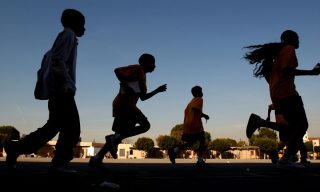
Most California parents assume that when they send their children to school on a hot day, someone is responsible for keeping them safe. They assume there are rules and that the adults in charge will notice if a child is struggling in the heat.
That assumption is not always true. Until very recently, it was not required to be.
On August 29, 2023, 12-year-old Yahushua Robinson went to Canyon Lake Middle School in Lake Elsinore. The high temperature that day reached 107 degrees. According to accounts from the day, Yahushua and other students were sent outside during physical education class and ordered to run laps as punishment for not suiting up in time. Yahushua told the school staff he was not feeling well, said he could not breathe and asked for water.
He was made to keep running.
Yahushua never came home from school that day. The Riverside County Coroner determined his cause of death was a heart defect, with extreme heat and physical exertion listed as contributing factors. His mother, Janee Robinson, is herself a P.E. teacher in the same district. That same afternoon, she kept her own students inside because of the heat. She later said, “These students should not have been outside, and to think that my child died while my students were in.”
That sentence should stop every parent in their tracks.
What Yahushua’s death exposed was a gap most families had no reason to know existed. In California and across the country, most heat safety policies were written specifically for organized high school athletics: football practice, cross-country and track. A high school football coach may be legally required to follow heat protocols. A middle school P.E. teacher had no comparable legal requirement.
Yahushua was not a high school athlete. He was a 12-year-old in P.E. class, and the system had no uniform standard designed to protect him.
That is what I set out to change.
Less than two weeks after Yahushua’s death, I prepared a formal advocacy brief on behalf of his family and began building the case for legislation. As a parent and family advocate, I understood that what was missing was not medical knowledge or parental love. What was missing was a legal standard that did not leave child safety to individual judgment during dangerous heat.
State Sen. Melissa Hurtado, a Central Valley Democrat, championed the cause and introduced Senate Bill 1248, with Assemblymember Akilah Weber, a doctor and Democrat representing the San Diego area, as principal co-author. The bill passed unanimously, and Gov. Gavin Newsom signed it into law in September 2024.
That law is known as Yahushua’s Law.
Here is what it does, and why every California parent needs to know about it before this summer.
California Education Code Section 33355 now requires every school district, county office of education, and charter school in the state to develop, adopt and implement a weather safety policy. The compliance deadline is July 1 — weeks away.
This is not guidance. It is the law.
Every policy must include clear criteria for modifying or suspending outdoor physical activities when conditions become dangerous, procedures for monitoring weather forecasts and alerts, communication plans for staff, students, and parents, access to indoor alternative activities, and staff training to recognize weather-related distress. These policies must be reviewed and updated annually, and the California Department of Education must identify schools that are not in compliance and provide technical assistance.
California now has one of the strongest and broadest student heat safety laws in the country because it covers all students across all grades in school-supervised physical activities, including P.E. class, recess and field trips.
This matters for your child specifically if they have asthma, a heart condition, sickle cell trait, obesity or a medication that affects heat tolerance. It matters if your child has an IEP or a 504 plan. It’s important because many children are too young, too scared or too overwhelmed to explain clearly and quickly when something is physically wrong.
The American Academy of Pediatrics has stated plainly that exertional heat illness in children is preventable when evidence-based protocols are followed by supervising adults. The science behind heat safety laws is not disputed. What has been missing is a requirement to act on medical guidance.
Now, California has that requirement.
But parents still have to ask whether their school is ready. If you live in California, call your district and ask: What is your weather safety policy under SB 1248, and when will staff be trained? If you do not get a clear answer, keep asking. The law says your child’s school must have this in place, and you have every right to know whether it does.
If you live elsewhere, connect with your own state lawmakers about passing similar legislation. The California law can serve as a model for other states.
Yahushua used to say, “I AM HIM.” His family carried those words into legislative hearings, conversations with lawmakers, and every act of advocacy that turned grief into law.
Every child who walks onto a school campus is someone’s Yahushua. This summer, the adults in California responsible for your children are required to follow a standard designed to bring every student home.
Make sure your school is ready to keep that promise.
Christina Christopher Laster is a parent advocate and policy and legislation strategist. She served as the family representative and policy architect during the advocacy campaign that produced California’s SB 1248, known as Yahushua’s Law. She is a practitioner on the Hoover Education Success Initiative (HESI) Practitioner Council at Stanford University.