America Is Ready for Family Math. Let’s Make It the Next Parenting Habit
Holly Kreider and Michelle Torgerson | October 6, 2026
Your donation will help us produce journalism like this. Please give today.
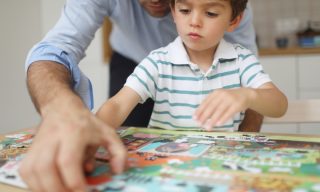
Math learning begins while counting blocks on the living room floor, comparing ingredients while cooking dinner or gathering around a favorite board game. These joyful, everyday interactions build number sense, reasoning, confidence and problem-solving during one of the most important periods of a child’s brain development.
It’s time to reinvigorate math education by acknowledging that every member of the community has a role to play.
That work has already started In Los Angeles, where nearly $1 million has been invested to help 1,000 public school students in Boyle Heights, South Los Angeles and Watts strengthen early math through family engagement, play-based learning, books and games. Made possible by the California Masonic Foundation, the initiative is occurring across four campuses in the Partnership for Los Angeles Schools and reflects a growing recognition that children’s mathematical development doesn’t begin and end at the schoolhouse door.
The movement recently gained major momentum from a group of governors jointly asking the American Academy of Pediatrics to consider something ambitious and remarkably simple: the development of national guidance encouraging parents to make playful math activities part of everyday family life, much as the AAP encourages parents to read aloud to their children.
The timing could not be better, and as partners in the Los Angeles project, we could not agree more.
Practitioners have spent years building what this moment requires. The Center for Family Math has helped communities bring math into homes through practical resources and professional learning. Raising a Reader, long recognized for demonstrating the power of family engagement in early literacy, is now helping families build those same habits around mathematics. PowerMyLearning’s MathVoice uses play-based activities to help children explain their thinking while providing families and teachers deeper insight into their mathematical reasoning.
Although each of these efforts looks a little different, they all point to the same conclusion: Children learn more math when families are engaged.
For years, researchers, educators and family-serving organizations have demonstrated that joyful, everyday interactions strengthen the foundational skills children need to enter school ready to learn. Families who engage children in playful math conversations and activities help build early numeracy alongside curiosity, persistence, executive function, and positive attitudes toward problem-solving. These healthy parent-child interactions should be encouraged by pediatricians because they support healthy development far beyond the classroom.
Yet despite this body of evidence, family math has never become part of the guidance that nearly every new parent receives. That is why the governors’ request and a growing petition from a community of experts and citizens matters.
The AAP has done this before. Its guidance encouraging parents to read aloud to their children beginning in infancy did far more than change conversations inside pediatric offices. It helped establish a new parenting norm. Pediatricians, libraries, schools, nonprofit organizations, publishers and families all began reinforcing the same simple message: Reading together supports healthy brain development, strengthens parent-child relationships, and prepares children to thrive.
We believe family math has reached a similar moment. Today, promising examples are emerging across the country. Schools send home math games instead of worksheets. Libraries host family math nights. Community organizations share multilingual resources that help parents confidently incorporate math into everyday routines. Researchers continue to strengthen the evidence behind playful learning, while family engagement organizations translate that research into practical tools for families.
These efforts are demonstrating what is possible. But they remain just that: examples. Most families will never encounter these opportunities unless they happen to live in the right community, attend the right school, or connect with the right organization. The AAP has the credibility to transform these examples of successful local innovation into a national parenting norm.
An AAP recommendation would provide a common message to reinforce. It would give parents knowledge and confidence that playing cards, counting steps, comparing quantities while shopping, building with blocks or gathering around a favorite board game are more than enjoyable family moments. They are opportunities to support healthy brain development while laying the foundation for future mathematical thinking and academic success.
Perhaps most importantly, it could help change one of America’s most persistent cultural beliefs. For too long, we have accepted the idea that some children simply are not “math people,” but few parents would say reading simply isn’t for their child. Practitioners working with children and families know this isn’t the case. Children are naturally curious about numbers, patterns, shapes, comparisons, and puzzles. When families are given simple, joyful ways to nurture that curiosity, children respond.
Organizations like ours have been building the programs, developing the resources, partnering with schools, and learning alongside families. We know these approaches work because we see them working every day. Now it’s time for national guidance to catch up.
Holly Kreider is director of the Center for Family Math at the National Association for Family, School and Community Engagement.
Michelle Torgerson is president and CEO of Raising a Reader.