Amid the Emerging AI Economy, We Need a Skilled Trades Pipeline in High School
Danny Corwin and Jennifer Dewees | August 11, 2026
Your donation will help us produce journalism like this. Please give today.
Across the economy, Americans are watching an artificial intelligence investment boom reshape the job market. Some of the same companies spending hundreds of billions to build the AI future are also announcing sweeping job cuts, adding to an already daunting employment landscape for college graduates.
In other sectors, opportunity is booming. Homes, roads, bridges, vehicles, energy grids, water systems and data centers all depend on skilled workers to build and maintain them. Yet demand far outstrips supply: McKinsey & Company estimates that for every new hire in skilled trades like carpentry, electrical work and welding, roughly 20 positions remain unfilled.
This raises a simple question: If the economy urgently needs more skilled trades workers, why aren’t we making a greater investment in our public high schools to help prepare students for these in-demand, well-paying careers?
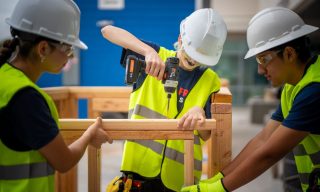
Unfortunately, the role high schools once played in preparing students for careers has diminished greatly. Traditional shop classes in auto repair, electrical, construction and other hands-on fields have disappeared from many public high schools over the past several decades. Though modern career and technical education programs are growing, they don’t yet have the reach or capacity to meet demand. Too many high students still don’t have meaningful exposure to career pathways in the skilled trades.
New national research conducted by NORC at the University of Chicago and commissioned by Harbor Freight Tools for Schools shows overwhelming support for expanding skilled trades education in public high schools. Students want it. Parents want it. Voters across party lines want it.
The survey of more than 6,000 U.S. voters, parents and public high school students found that 95% of voters and 81% of parents believe more opportunities to study skilled trades in high school would better prepare students for careers; 84% of voters and 73% of parents support increased government funding.
That kind of agreement is rare in American politics, and the strong support among parents reflects their fears about the future labor market. Nearly half of parents surveyed said they are extremely or very concerned that AI will reduce job opportunities for their child.
The AI era only makes modern skilled trades education more urgent. This research shows broad consensus that high school should prepare students not only for college admission but also for careers with stability and purpose..
All high school students should have the opportunity to explore a skilled trade. Some will discover a lifelong career. Many will gain practical skills and confidence. And others will go on to college with a clearer sense of purpose.
The NORC survey found high school students who have taken skilled trades classes report stronger connections to school and greater confidence about their future, even if they don’t enter the trades. Those students felt more confident collaborating and problem-solving than their peers.
Voters see it clearly, too. They ranked skilled trades as the top elective funding priority for high schools, ahead of STEM, business, healthcare, arts and physical education. That does not mean those subjects are unimportant. It means the public sees a skilled trades gap that has been ignored for too long.
With students, parents and voters all wanting stronger pathways into the skilled trades, public policy should reflect that consensus.
That requires real investment in modern school facilities, up-to-date equipment, trained instructors, career counseling and schedules that allow students to take skilled trades classes that are aligned with core academics. It also requires expanding partnerships with employers and community organizations to provide apprenticeships and opportunities for students to earn industry credentials, accelerating their entry into the workforce upon graduation.
Strengthening and expanding skilled trades pathways in public high schools is one of the most forward-looking steps we can take in an economy being reshaped by artificial intelligence, infrastructure needs, and uncertainty about the future of work.
The high school students who will build, repair, power, and maintain the country’s future are sitting in classrooms right now. They should not have to wait until after graduation to discover what they are capable of doing with their hands, their minds and their ambition.
Danny Corwin is executive director of Harbor Freight Tools for Schools, which aims to increase understanding, support and investment in skilled trades education in U.S. public high schools.
Jennifer Dewees is president of the Maryland Center for Construction Education and Innovation, a nonprofit workforce intermediary that inspires, educates and connects a diverse population to careers in the built environment.