These California School Districts Are Losing Students — But They’re Gaining Infants and Toddlers
Kate Rix | October 21, 2026
Your donation will help us produce journalism like this. Please give today.
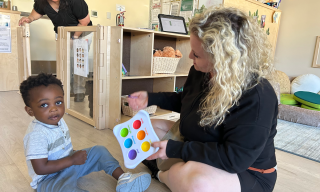
Less than a year after dwindling enrollment forced the closure of three elementary schools, California’s Berryessa Union School District added small, child-sized sinks and toilets at one campus to serve 150 infants, toddlers and preschoolers.
The district knew there was unmet need for affordable childcare in the community north of San Jose, as there is throughout California. But school leaders are also betting the babies and toddlers now in care at the new Toyon Early Learning Center will stay when they’re ready for transitional kindergarten and reverse enrollment trends.
“It was really about trying to find another avenue of getting to families before age four,” said Berryessa Superintendent Roxane Fuentes. “One thing we know about our families is once they experience our schools, they stay with us.”
Districts can’t control most of the factors driving enrollment decline. Birth and immigration rates are down across the country and the cost of raising a family is only going up. But as California invests in subsidized childcare, leaders in districts throughout the state see an untapped population in young children and their families.
Earlier this year the Los Angeles Unified School District board voted to expand the district’s early education programming, both to address unmet need for childcare and as a strategic move to pull in more families down the line.
“My belief is that once families start in our system, as long as we’re serving them well, then they will want to stay with us,” said Kelly Gonez, the board member who proposed the expansion. “A lot of our early education centers are right next to an elementary school and have developed a stronger relationship with families.”
The plan in Los Angeles is to use empty elementary school classrooms for additional preschool and reopen previously closed district childcare centers, doubling the district’s infant care programs. Eventually, said board member Tanya Ortiz-Franklin, the district may use facilities made available after school consolidations, which will be on the table this year as the district addresses a $3.6 billion deficit.
“We know there’s a lot of need and if we have space available, many of us are eager to make sure that our families can get those kinds of needs met,” Ortiz-Franklin said.
Los Angeles Unified Schools are still figuring out exactly where the need for childcare is highest, but the general demand for affordable care is already clear. Research from 2024 shows that only eleven percent of children who qualify for subsidized childcare in Los Angeles county are enrolled in a program.
But attracting more families with young children into district facilities and programs doesn’t necessarily translate into more kindergarteners later, said Erica Greenberg, a senior fellow at the Urban Institute. Greenberg, whose research focuses on public pre-kindergarten policy, said that reaching out to families with young children helped Washington, D.C., Boston and Tulsa to boost enrollment.
She said that the programs in these cities cleared two hurdles for families: cost and convenience. In Washington D.C. and Boston — where the cost of living is high — expanding subsidized preschool made it possible for more parents to work and stay in the district.
“To the extent that gentrification or rising housing costs are why families might not be enrolling in L.A. schools, it is possible that more affordable childcare in public school buildings could solve that problem and could keep them living in LA,” Greenberg said.
Boston and Washington D.C. also made the school enrollment process easy for families, she said. Districts made the steps clear and even created eligibility guidelines that admit children who attended preschool in district facilities but live outside of the catchment area.

Berryessa has not put an admissions eligibility guideline in place. The nonprofit that operates childcare programming at Toyon Early Learning Center hosts parenting education events in the former elementary school’s auditorium and district leadership often make presentations, said Fuentes.
“That’ll also be a good opportunity for our district to be present in the spring, when we have open enrollment, to go and showcase our TK and kinder programs,” she said. “We can be right there on campus on site and give them that information.”
To provide infant and childcare, Berryessa leased the Toyon campus to Kidango, a large nonprofit childcare provider that serves about 4,000 children in the East Bay region. Kidango’s CEO Scott Moore said as school enrollments have steadily plummeted over the past two decades, Kidango has typically leased empty classrooms on school grounds. But in 2021 the state made a massive investment in subsidized childcare, adding 200,000 new slots and raising the hourly reimbursement rate for caregivers.
“That has enabled us to significantly expand our services,” Moore said. “Obviously no one wants to have to close elementary schools, but if you can transform them into early learning campuses, that certainly is a good way of using that campus providing families with a really needed service.”
Even with increased state funding, it’s expensive to convert an elementary school into a childcare center. Licensing requires small toilets and sinks in each classroom. Sometimes separate entrances and exits need to be added to buildings for very young children. There needs to be laundry facilities on-site and enough parking and space for additional staff.
Earlier this year the nonprofit childcare provider Child Start opened a new facility in Vallejo, north of Oakland. Divided by a freeway, half of Vallejo is a childcare desert where the poverty level is high and licensed care is scarce. When Child Start had to move out of classrooms they were leasing from an elementary school so the school could use them for transitional kindergarten, the company investigated buying its own building. With help from state and county early education agencies, they were able to purchase a former elementary school for $2 million, in the part of Vallejo that needed childcare the most.
But renovating the former Beverly Hills Elementary into a flexible facility for infants, toddlers and preschoolers cost another $18 million. The 1950s building had sat empty for two years after being closed in 2020 and the facility needed renovation inside and out.
The new facility is called Vallejo Rise and it’s set on a hillside in a quiet residential neighborhood. New, fenced-in outdoor play areas are covered in redwood bark and include new trees, too young to provide shade.
As an early education center, the campus has space for five providers that operate out of fifteen newly furnished classrooms. As the owner of the building, Child Start charges the four other providers for the operational costs of the classrooms they use. The entire facility is licensed to care for 200 children.
Inside an infant/toddler classroom run by A Place to Grow, manager Alexandra Castaner plays with two baby boys who lie on a soft mat under mobiles. Castaner loves working in the Rise Vallejo center because it has everything she and the children need. The hardest part is finding staff.

“It’s a juggling act, finding teachers,” Castaner said, holding a baby on her lap. The classroom has eleven children enrolled and a waiting list of ten.
A few doors down along an outdoor breezeway are classrooms run by Joyful Journeys. Owner Dionna Perkins offered childcare out of her home for fourteen children before moving into space at Vallejo Rise. Now her company cares for 33 children.
There is no formal transition plan with Vallejo Union City Unified School District when children are old enough for kindergarten, said Susan Smith, deputy director of Vallejo Rise. But families receive a transition packet that explains the enrollment process and a local kindergarten teacher comes to a meeting with parents to discuss ways to get children ready for elementary school.
That may or may not be enough to attract families to enroll in Vallejo schools, since families are often interested in districts where they feel comfortable or have an established relationship.
That’s what leaders in Los Angeles are banking on.
“If families have a good experience with LA Unified preschool, they’ll stay with us long term,” said board member Ortiz-Franklin, “because we’ve built that trust and shown them the great education their kids can get.”
This article was published in partnership with The 74. Sign up for The 74’s newsletter here.