Gutting EPA Rules on Toxic Chemicals Puts Millions of Schoolkids at Risk
Dominique Browning and Cynthia Palmer | July 22, 2026
Your donation will help us produce journalism like this. Please give today.
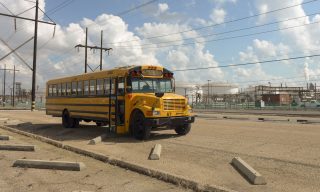
Getty Images
Chemical fires, leaks and explosions happen at U.S. industrial facilities every other day — incidents such as four disasters in greater Los Angeles over Memorial Day weekend, including one involving a chemical tank that threatened to explode and forced 50,000 residents and more than 20 schools to evacuate, and a chemical tank explosion the next day in Longview, Washington, that killed 11 men.
Yet the Environmental Protection Agency is proposing to gut the very program protecting Americans from such disasters, the Risk Management Program. The program was mandated by Congress in response to the 1984 Bhopal India chemical disaster, in which a pesticide factory owned and operated by the U.S.-based Union Carbide Corp. leaked toxic methyl isocyanate gas, killing thousands.
Children are the most vulnerable to chemical disasters. Their bodies are going through rapid and delicate developmental phases, and their immune systems — the primary defense against infections, diseases and harmful chemicals — are physiologically immature. It takes only tiny quantities of a hazardous chemical to cause life-altering and sometimes life-ending harm. Cancers and other ill effects can emerge at any time in the following days, years or even decades, and also in future generations.
It is obvious that the nation’s barebones and outdated industrial safety systems desperately need strengthening, not weakening, and that an expansion of the Risk Management Program’s chemical list is long overdue. The program regulates just 140 chemicals, and only when they are stored in massive quantities. MMA, the volatile toxic chemical that triggered the evacuations in Southern California, is not even on the list, nor is ammonium nitrate, a fertilizer chemical that exploded in West, Texas, in 2013, killing 15 and injuring hundreds. Had that disaster occurred in the daytime, some 1,486 students and 191 staff at nearby schools could have been harmed, according to the U.S. Chemical Safety and Hazard Investigation Board. Ammonium nitrate is the same chemical that burned in a Winston-Salem, North Carolina, fertilizer plant in 2022, engulfing communities in toxic smoke and threatening to become one of the worst disasters in U.S. history. The site is adjacent to daycare centers, grade schools and colleges, including Wake Forest University. The country has nearly 1,400 other facilities that store this same chemical.
A recent analysis found that more than 80% of schools and 86% of childcare centers are located within 10 miles of facilities that use or store large quantities of chlorine, hydrogen fluoride or other extremely dangerous substances. Often without knowing it, families live, work or go to school in chemical disaster vulnerability zones, the highest-risk locations based on chemical toxicity, blast potential, topography and other factors.
Utah, Rhode Island, Texas, Louisiana and Nevada have the largest proportion of schoolchildren in such zones. Kids in Houston and Beaumont-Port Arthur, Texas; Baton Rouge, Louisiana; Memphis; and Wilmington, Delaware face even greater danger, with many schools located in multiple overlapping vulnerability zones. Children at San Jacinto Elementary School in Deer Park, Texas, are in the vulnerability zones of a staggering 41 chemical facilities, and 10 high-risk facilities. New Jersey, Texas, California and Illinois each have vulnerability zones that expose over 500,000 children to chemical risks.
The Risk Management Program applies to over 11,000 chemical manufacturers, water treatment plants, industrial agriculture facilities, pulp and paper mills, and other facilities that use, store and manufacture immense quantities of toxic and flammable chemicals. It requires them to develop plans to prevent and mitigate chemical disasters. But the Trump administration’s proposal would remove basic safeguards. For example, it would eliminate the requirement that those using the largest quantities of the highest-risk chemicals with the greatest potential for off-site impacts, and factories that experienced recent chemical disasters, document and sometimes implement safer alternatives. It would also weaken or eliminate third-party audits after disasters, remove mandates for backup power for monitoring equipment used to detect unplanned releases during emergencies, and do away with planning requirements for power loss and the risk of natural hazards such as hurricanes, flooding and wildfires.
The community members, environmental health and justice organizations, medical professionals and labor groups in our coalition have been petitioning the EPA to stop the rollback, but the agency has not responded. Everything this EPA is doing is shockingly reckless and callous, from doubling the amount of formaldehyde that the government considers acceptable to breathe, to approving five new pesticides made from “forever” chemicals, to proposing to exempt plastics incinerators from the safeguards of the Clean Air Act.
Millions of children live and go to school in the shadows of chemical plants and other industrial facilities. They deserve an EPA that goes the extra mile to protect them, not one that plays Russian roulette with their lives.
Dominique Browning is the director and co-founder of Moms Clean Air Force.
Cynthia Palmer is the senior analyst for petrochemicals at Moms Clean Air Force.
This article was published in partnership with The 74. Sign up for The 74’s newsletter here.