California Lawmakers Pass Budget With Billions More for Education as Newsom Negotiations Begin
John Festerwald and Zadiee Stavely, EdSource | June 16, 2026
Your donation will help us produce journalism like this. Please give today.
This story was originally published on EdSource.
Updated July 20, 2026
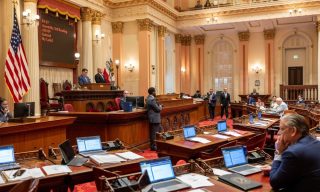
Marking the start of two weeks of intensive negotiations, the Legislature passed a state budget Monday with higher revenue projections than those proposed by Gov. Gavin Newsom, providing several billion dollars in additional spending for TK-12 and community colleges in 2026-27.
Several other significant issues remain unresolved. Chief among them is the $3.9 billion in education funding that Newsom would withhold until revenue projections — mainly tax receipts from taxpayers’ investments in AI stocks — come true. Education groups are threatening to sue over the delay.
June 15 was the constitutional deadline for legislators to pass a balanced budget or risk losing their pay for every day they’re late. They can amend the budget, as they usually do, before the next fiscal year starts on July 1, based on agreements with the governor.
In its current version, the Legislature’s budget adopted nearly all of what Newsom included in his May budget revision, with a record $127 billion for schools and community colleges. Legislators include a larger-than-required cost-of-living adjustment for most programs, $1 billion more for community schools, a $2.4 billion boost to ongoing special education funding and a $5 billion one-time block grant that districts and charter schools can spend however they want.
Barrett Snider, a founding partner of Capitol Advisors Group, a Sacramento-based school consulting firm, characterized Newsom’s budget as “a great budget for schools,” overall; most education advocates agree.
But the Legislature’s budget projects about $5 billion more in revenue than Newsom forecast just a month ago. That would translate to $2 billion more for schools and community colleges under Proposition 98, the formula that guarantees that 40% of general fund money goes to community colleges and schools. Combined with contributing $800 million less to the rainy day fund, freeing up that money for spending, the Legislature would mitigate some of the $3.9 billion that Newsom would withhold.
Here’s how the Legislature would spend most of the money:
- $700 million for districts to upgrade or add school kitchens — in line with the state’s priority that schools prepare fresh and nutritious meals. Family food pantries would be another use.
- $300 million one-time for career/technical education.
- $450 million on top of Newsom’s proposed $250 million to pay student teachers a stipend to teach in priority areas, including STEM and special education.
- $350 million more for the California newcomer’s program to assist refugees through 2032.
- $300 million more in assistance for homeless students, through 2032.
Contrary to what they have previously said, legislative leaders appear to be acquiescing to Newsom’s plan to withhold the $3.9 billion of forecasted Prop. 98 funding — only they want a clear repayment timetable. The joint Senate-Assembly budget summary says they commit “to a reliable schedule to pay districts the $3.9 billion omitted from the May Revision.”
Education groups, including the California Teachers Association and the California School Boards Association, view the withholding as a manipulation of the Prop. 98 minimum funding guarantee. They see it as a bad precedent — a tactic that has the effect of loaning money to meet the immediate expenses of other areas of the budget most affected by federal budget cuts, including Medi-Cal.
“This bill shortchanges our districts $3.9 billion they need right now, not in future budget years,” said Assemblywoman Laurie Davis, R-Laguna Niguel, in voting against the budget Monday night.
Some education groups are also unhappy about another financial and structural shift suggested by the Legislature, to move all funding for the California State Preschool Program into Prop. 98.
The preschool program, which provides free preschool for 3- and 4-year-old children from families who earn up to the state median income, is provided by school districts, private nonprofits and community colleges. Currently, funding for preschools run by school districts and community colleges (about $1.8 billion) is under Prop. 98, while funding for nonprofit and community-based preschools (about $1 billion) comes from the general fund.
This is not a novel idea, early education experts said. Before 2011, all state preschool and childcare funding was under Prop 98. The Legislature shifted the responsibility then to lighten the financial burden on schools, which were facing massive cuts as a result of the Great Recession. Now it’s the nonProp. 98 programs that are facing the most severe financial pressure, precluding additional funding for early education.
The proposal drew ire from the school boards association, which said it would hurt funding for TK-12 graders over time.
“The result would be simple and devastating: the same funding guarantee would be stretched across more students and programs, reducing per-pupil resources for school districts and county offices of education,” reads the statement from CSBA. “Early learning is essential and deserves strong, stable and dedicated funding. No one disputes that. Yet, Sacramento cannot fund one essential priority by weakening another.”
Scott Moore, the CEO of Kidango, one of the largest providers of state-subsidized preschools, said that, as an educational program, preschool deserves to be under Prop. 98.
“It’s a protected funding source that ensures that to the fullest extent possible, these programs get funded. It shouldn’t matter who the provider of state preschool is” — whether a district or a nonprofit, Moore said. “What matters is the program itself.”
The Legislature is also proposing to add about $270 million in funding to pay for subsidized childcare for 22,770 additional children from low-income families. That funding would remain in the general fund.
With the heavily Democratic Legislature behind it, the Senate approved the budget bill 28 to 9, with the Assembly following late Monday, after three hours of discussion, by a margin of 59 to 18.
Correction: This article was amended to reflect that community colleges were already funded under Prop. 98 and that about $1.8 billion for preschool programs was covered under Prop. 98 while about $1 billion came from the general fund.