Your donation will help us produce journalism like this. Please give today.
One of the many surprises of being a new parent is just how many diapers a tiny baby can go through in a day. In the haze of those first weeks and months adjusting to having an infant, parents shouldn’t have to worry about whether they can afford enough diapers — or what financial sacrifices have to be made to purchase them. But far too many families with young children struggle to provide a sufficient supply of diapers to keep their baby clean and dry.
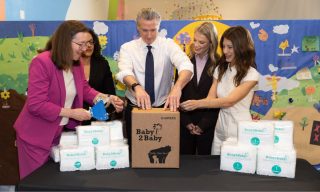
California is doing something about diaper insecurity for its residents. Gov. Gavin Newsom recently announced that the state will provide 400 free diapers to families with newborn babies, beginning with hospitals that predominantly serve low-income households, before expanding more broadly.
Diaper need is a serious challenge for many families. As many as 40% of U.S. households with children under age 4 in diapers report diaper insecurity, according to a nationally representative study from the nonprofit National Diaper Bank Network. An infant typically goes through 8-12 diapers in a day. At around 30 cents a pop, the annual diaper cost for one baby can run roughly $1,000 during the first year. These costs hit during a period when families are often experiencing a negative income shock due to the combination of baby-related costs and employment challenges driven in part by America’s lack of robust paid family leave laws.
The consequences can be harmful: When parents can’t afford enough diapers, they may turn to alternatives like using plastic bags or towels to make their own diapers, or reusing wet or soiled diapers. These practices can lead to severe diaper rash and urinary tract infections. In my work, I have spoken to childcare providers who describe the phenomenon of “Monday morning rash,” when babies arrive after having diapers stretched over the weekend.
Cloth diapers present an alternative that can save parents a lot of money, but they aren’t a viable option for many families because they require up front costs, need frequent laundering — which can increase utility bills — and importantly, because many center-based childcare programs won’t allow them.
In fact, many childcare providers require parents to provide disposable diapers, and if they’re unable to do so, they may not be allowed to drop their children off. In a 2016 survey of Connecticut diaper bank users, more than half of parent participants who relied on childcare programs reported missing work due to a lack of diapers, with an average of four missed days per month.
While the long-term solution to diaper need likely lies in ensuring all families have access to reliable and well-paying jobs, a statewide program like California’s Golden Gate Start can provide a strong preventative intervention that can set families off on the right foot, helping them leave the hospital with one less worry while they try to figure out how to care for the beloved, squalling creature that’s coming home without an instruction manual. In practice, the 400 diapers, which come in varying sizes, should cover about a month’s supply.
California is not the first state to try to tackle diaper insecurity. Illinois has, since 2023, been utilizing Diaper Dollars, a statewide initiative that sends out a monthly $40 e-card to eligible families that can be used to purchase diapers at various stores, and the idea has since spread to Ohio. In 2024, Tennessee launched a program that offered 100 free diapers a month to families enrolled in the state’s Medicaid system, although the program is being phased out in 2027 as the state legislature tries to shore up healthcare budget holes.
California’s model, though, may have the most straightforward delivery system. Diaper Dollars has faced challenges because the stipends can only be used at participating stores and some major retailers don’t currently accept that form of payment, while Tennessee struggled with coverage because it delivered the benefit via pharmacies, and a paucity of participating stores left many families lacking options. California’s use of hospitals is innovative, though it does mean only a one-time infusion of diapers versus an ongoing supply.
Despite the fact that California’s program seems like a clear win, it has drawn criticism. While plausibly driven by animus toward Newsom, a possible 2028 presidential contender, commentators have focused on the fact that a nonprofit with connections to Newsom’s wife, Baby2Baby, is involved in the administration of the free diapers. Some see Newsom’s free diaper program as politically flashy but economically tokenistic, arguing that giving new parents 400 diapers does little to solve the real reason California feels unaffordable — especially the state’s severe housing shortage and high cost of living. Others suggest routing diapers through a nonprofit and hospitals may cost taxpayers more than simply handing families cash directly.
This argument almost entirely misses the point. While it’s always worth watching the implementation of a benefit to make sure the government is working efficiently, the question on the table is whether there is a public interest in helping all parents and babies get off to a strong and healthy start. As conservative analyst Patrick T. Brown wrote in his Family Matters Substack, “even if the program design could theoretically stand to be improved, it hardly deserves the scorn being directed at it. … Sometimes a program can be good without being perfect; and sometimes we should do a better job resisting the temptation to hold our political opponents’ ideas to a higher standard than our own side’s.”
Indeed, American families would surely welcome a race among states to figure out how to most effectively support them in securing an adequate diaper supply. Babies need diapers, but especially as the cost of living continues to rise, not every American family is in a position to provide them. California is taking action: that in itself is worthy of praise — and one way or another, there will be important lessons to learn.