California’s Learning Recession Won’t Be Solved with More Test Prep
Jaime Balboa | June 17, 2026
Your donation will help us produce journalism like this. Please give today.
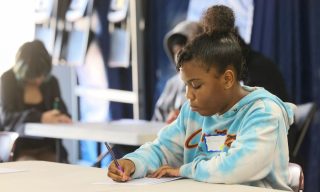
Recently, researchers at Dartmouth, Harvard and Stanford released the annual Education Scorecard, which points to a long-entrenched learning recession in American K-12 education.The latest reading achievement data tells a troubling story: Reading scores remain below pre-pandemic levels in many of the nation’s most under-resourced school districts. Equally concerning, researchers found that declines in reading achievement began well before COVID-19, suggesting that the pandemic accelerated a crisis that was already underway.
Californians are familiar with this challenge. Results from the most recent Smarter Balanced assessments show that fewer than half of Californian students meet English Language Arts standards, a benchmark we have struggled to reach long before the pandemic disrupted learning.
But focusing on declining test scores risks missing the deeper issue entirely.
What’s at stake is not whether students can pass an assessment. It’s whether young people have opportunities to develop their voices, build confidence in their ideas and view themselves as capable readers and expressive writers.
Students succeed when literacy is reinforced not only by teachers, but also by an entire community of adults who believe their voices are worth developing.
In my work with students across Los Angeles, I see firsthand what’s working to ensure student success. I lead free writing workshops for high school students in Echo Park and South Central LA through an out-of-the-box partnership with the Trident Swim Foundation. Trident’s swim coaches, embedded at high schools, create the expectation that students show up — sometimes before school, sometimes after — to writing workshops. In this recipe, supportive school administrators team up with invested coaches and, together, we send the message to students that we care about their learning because we care about them.
Research increasingly supports what teachers and community organizations have long understood: Literacy grows through practice, repetition and meaningful engagement. The keyword here is meaningful and includes books that are meaningful to students and writing assignments that enable expression of student thoughts on topics meaningful to them, in a context of meaningful relationships with adults and peers.
This is why community-based collaborations make a difference.
Literacy support cannot rely solely on interventions designed to improve test preparedness. Students need safe third spaces for creative expression, mentorship and access to books. They need environments where learning continues outside of school hours and where expectations are set not only by teachers and parents, but by others like coaches and volunteer mentors.
Students who struggle with reading will struggle to express themselves in writing. Students who lack confidence in writing frequently disengage from reading altogether. And students who are immersed in safe third spaces will feel emboldened to embrace the struggle and improve with practice and support.
Through my work with students, I’ve seen how free tutoring, writing workshops, publishing opportunities, summer writing camps and one-on-one mentorship transform how students understand themselves. When young people are encouraged to tell their stories and share their ideas, they begin to understand that their voices matter.
And that confidence matters not only when it comes to test preparation, but as a life skill that they will carry with them well beyond their school years.
The Education Scorecard and the Smarter Balance assessments prove that this work is especially urgent now.
National conversations about literacy often focus on curriculum debates (yes, teach phonics), test scores (yes, measure student progress), class management (yes, limit screen time), and learning recovery data (yes, pay attention to trends).
But those conversations are most productive when they lead to investment in the broader ecosystem that supports young people: libraries, after-school programs, youth centers, arts education, tutoring programs and other third spaces where students can safely learn, create and grow.
Literacy is not built in isolation but through relationships, encouragement and consistent opportunities to practice reading and writing in meaningful ways about topics that are meaningful to students. If we want stronger test scores, we should invest in the conditions that make literacy possible.
Jaime Balboa is the executive director of 826LA, a writing-based literacy organization that provides joyful, free writing programs to thousands of students each year.